Awhile ago I had heard about the book "The Immortal Life of Henrietta Lacks" by Rebecca Skloot. I finally got to read it and it is a fascinating story as it reviews the science of using human cells in research and a woman's life story. The other stories told in the book are about her children and her family and their life struggles.
This story is non-fiction and is about an African American woman, Henrietta Lacks, who had an aggressive form of cervical cancer in the early 1950's. She died in Baltimore from complications created by this cancer. Unbeknown to her and her family, samples of the cancer tumour were taken by her doctor to see if he could grow these cells in a laboratory environment. In previous attempts by this doctor and others, human cells did not survive in petrie dishes and nourished by a medium, divide and keep on multiplying. Henrietta's cells were different.
Cells from Henrietta Lacks were the first cells to survive in a petrie dish and actually flourish. These cells were named HeLa based on her initials. These cells were the first live cells that were successfully shipped in the mail to other researchers in the United States. These cells were used to test the newly developed polio vaccine, the Salk vaccine. The HeLa cells were used to test all sorts of viruses, how cells react when exposed to radiation, the effects of steroids, chemotherapy, drugs, hormones and vitamins. Henrietta's cells were sent up in the second satellite to go up into orbit and were used to study the effects of radiation levels and when the first humans went into orbit, Henrietta's cells went with them so that researchers could study the effects of space travel. Researchers did find in space mission after space mission in zero gravity, that the HeLa cells became more powerful and were dividing faster with each trip while noncancerous cells grew normally in orbit. As cited in this book, when this book went to the printers in 2009, more than 60,000 scientific articles had been published about research done on the HeLa cell lines.
There are many ethical and legal questions raised in the Immortal Life of Henrietta Lacks. Rebecca Skloot does discuss the issue of using Henrietta's cells without her knowledge or consent. Furthermore, she elaborates on the issue of tissues being kept and stored in laboratories when you get biopsied, have moles removed, appendices or tonsils removed, and so on. The tissues that get removed don't always get thrown out. In a report published by the RAND Corporation in 1999, it estimated that more than 307 million tissue samples from over 178 million people were stored in the U.S. alone. These samples come from routine medical procedures, tests, operations, clinical trials and research donations. Research Institutes are also gathering tissue samples for mapping cancer genes. What the issue boils down to is consent to use your tissue for research, finding out potentially damaging information about your genes and medical history and finally a pharmaceutical company making money selling drugs based on research done using your tissue samples. Most research institutions do get consent from patients for any tissues that might be used in research but there is not always uniformity. There are also issues about whether donors have the right to determine what kind of research they do not want their tissue samples to be used on -- nuclear weapons, abortion, racial differences, intelligence and so on. The author reviews a number of litigation cases currently before the courts dealing with the control of tissue samples. Issues include privacy, how your DNA is being used, gene patents and control over how the tissue samples are being used. The opportunity for potential financial gain that might transpire from using people's tissues is also discussed at the end of this book.
The author has extensively researched this book and spent a number of years assembling information including recreating the life of Henrietta Lacks. I enjoyed reading this book and recommend it. In reading the life story about Henrietta Lack, I wondered if life's circumstances for her family would have turned out differently if Henrietta or her family would have been told about her cervical tissue samples being taken at the onset and if she was white in colour instead of being black.
Sunday, July 29, 2012

Wednesday, July 25, 2012
KELP NOODLES
I have seen kelp noodles in the grocery store, in the refrigerator section, but never bought any until today. I stopped in at a locally owned grocery store to pick up a few things and decided to try a package. The package was under $6.00. These kelp noodles do not require cooking. They are very low in carbs and calories and have zero grams of fat. They are also very low in sodium. They are not noodles that would be added to hot dishes. I think they are better suited for salads.
To use them, I opened up the package and placed them in a big bowl of water. I then drained what I wanted to use. I used about 2/3 of the package and what was left was placed in a container with water and put in the fridge.
The noodles are long and stringy so I cut them using a knife into smaller pieces. I decided to make a vegetable vietnamese salad. I made individual salad bowls and using the noodles as the base in the bowl, I added chopped carrot, cucumber, red pepper, mushroom, and cilantro. The dressing was similar to the dressing used in this soba noodle salad. Instead of using lime juice in the dressing, I used rice vinegar.
Both the DH and I enjoyed the kelp noodles. Their texture is crunchy and not soft like cooked pasta.
To use them, I opened up the package and placed them in a big bowl of water. I then drained what I wanted to use. I used about 2/3 of the package and what was left was placed in a container with water and put in the fridge.
The noodles are long and stringy so I cut them using a knife into smaller pieces. I decided to make a vegetable vietnamese salad. I made individual salad bowls and using the noodles as the base in the bowl, I added chopped carrot, cucumber, red pepper, mushroom, and cilantro. The dressing was similar to the dressing used in this soba noodle salad. Instead of using lime juice in the dressing, I used rice vinegar.
Both the DH and I enjoyed the kelp noodles. Their texture is crunchy and not soft like cooked pasta.
 |
| Packaging from the noodles |
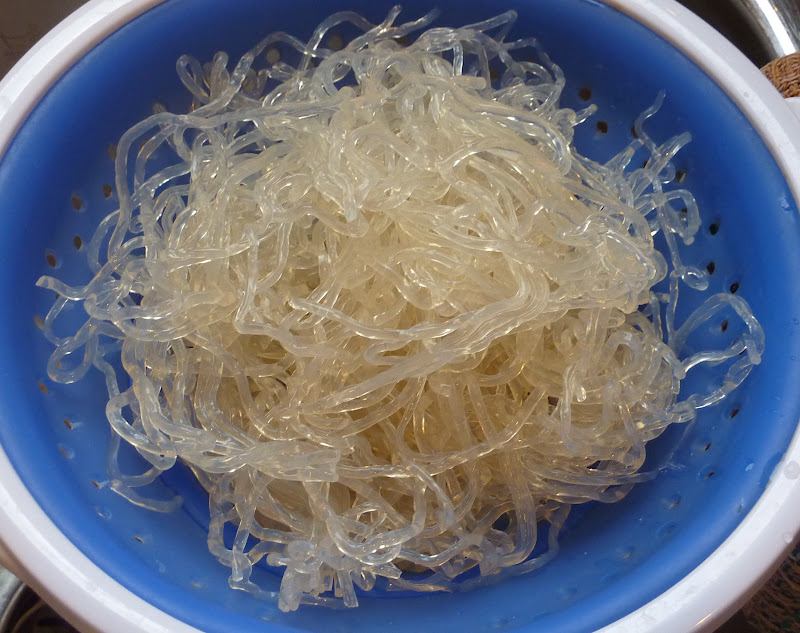 |
| Kelp noodles draining. |
Friday, July 20, 2012
SALMON WITH ALMOND AND PARSLEY TOPPING
While visiting with friends I was served this delicious salmon which had an almond and parsley topping. My girlfriend provided me with the list of ingredients and I figured out the proportions. I made a light coating for the almond and parsley topping and you could increase the amounts to make a heavier topping.
This is a wonderful recipe and both the DH and I enjoyed it. I served the salmon with lemon wedges, new potatoes roasted in the oven and salad.
INGREDIENTS:
2 lbs salmon fillet
dijon mustard
10 almonds, chopped
small handful of parsley, chopped
1 green onion, chopped
zest from half a lemon
juice from half a lemon
3 tbsp maple syrup
DIRECTIONS:
Place the salmon on a baking tray lined with parchment paper or tin foil. If using tin foil, I spray the tin foil with Pam before placing the fillets on the pan. Thinly spread the fillets with dijon mustard.
In a separate small bowl, combine the remainder of the ingredients. Spread this mixture over the salmon as a topping. Bake in the oven at 400 degrees F until cooked (25 minutes) or cook on the barbecue. Serves four.
 |
| Almond and parsley mixture. |
 |
| Mixture is spread on the salmon before baking. |
 |
| Cooked and ready to be served. |
INGREDIENTS:
2 lbs salmon fillet
dijon mustard
10 almonds, chopped
small handful of parsley, chopped
1 green onion, chopped
zest from half a lemon
juice from half a lemon
3 tbsp maple syrup
DIRECTIONS:
Place the salmon on a baking tray lined with parchment paper or tin foil. If using tin foil, I spray the tin foil with Pam before placing the fillets on the pan. Thinly spread the fillets with dijon mustard.
In a separate small bowl, combine the remainder of the ingredients. Spread this mixture over the salmon as a topping. Bake in the oven at 400 degrees F until cooked (25 minutes) or cook on the barbecue. Serves four.
Saturday, July 14, 2012
TOMATO, ONIONS AND BASIL SAUCE WITH PASTA
The other night I wanted to make a quick and easy supper. Using ingredients from the fridge and garden I made a simple pasta sauce. The ingredients can vary depending on what you have in the fridge. One ingredient that is a treat to have on hand is fresh basil. I have three basil plants growing in the garden and with the summer heat they are growing well.
INGREDIENTS:
1 tbsp olive oil
1/2 onion, chopped
2 garlic cloves, chopped
1 small orange or yellow pepper, chopped
4 small tomatoes, coarsely chopped
handful of fresh basil, thinly sliced
salt and pepper to taste
1/2 pound of pasta such as spaghetti or linguine
DIRECTIONS:
In a medium size pot, heat water (half a pot full) to a boil. Add the pasta to the water and reduce the heat to medium. Cook until al dente and then drain the pasta. Set aside in a serving bowl.
While the pasta is cooking, heat the olive oil in a medium size fry pan to high heat, add the onion and garlic, reduce the heat to medium low and saute for three to four minutes. Add the pepper and tomatoes, combine the ingredients in the pan and continue to saute for five minutes. Add the basil and salt and pepper. Cook for another minute and pour over the pasta in the serving bowl. Combine and ready to serves. Makes 4 servings.
Note: to thinly slice the basil, I take the handful of basil leaves and roll them together like a cigar. While holding the basil leaves in one hand, I thinly slice the leaves using a serrated knife.
 |
| The sauce included fresh basil from the garden, onion, peppers and tomatoes. |
 |
| Vegetables sauteing in the frying pan. |
 |
| Ready to serve. |
1 tbsp olive oil
1/2 onion, chopped
2 garlic cloves, chopped
1 small orange or yellow pepper, chopped
4 small tomatoes, coarsely chopped
handful of fresh basil, thinly sliced
salt and pepper to taste
1/2 pound of pasta such as spaghetti or linguine
DIRECTIONS:
In a medium size pot, heat water (half a pot full) to a boil. Add the pasta to the water and reduce the heat to medium. Cook until al dente and then drain the pasta. Set aside in a serving bowl.
While the pasta is cooking, heat the olive oil in a medium size fry pan to high heat, add the onion and garlic, reduce the heat to medium low and saute for three to four minutes. Add the pepper and tomatoes, combine the ingredients in the pan and continue to saute for five minutes. Add the basil and salt and pepper. Cook for another minute and pour over the pasta in the serving bowl. Combine and ready to serves. Makes 4 servings.
Note: to thinly slice the basil, I take the handful of basil leaves and roll them together like a cigar. While holding the basil leaves in one hand, I thinly slice the leaves using a serrated knife.
Tuesday, July 10, 2012
TAHINI LEMON SALAD DRESSING
I use both store bought salad dressings and ones that I make myself. I do like tahini and the jar does last a long time in the fridge. Tahini can be used in a variety of ways including as part of a marinade and for making hummus. If you don't have tahini, you can substitute it with almond butter.
INGREDIENTS:
2 tbsp oil - olive oil or canola
4 tbsp tahini
3 tbsp lemon juice
1/3 cup water
1 to 2 tbsp tamari sauce (use soy sauce if you don't have tamari)
1 tbsp red onion or green onion, finely chopped
1 garlic clove, minced
1 tbsp maple syrup
DIRECTIONS:
Combine all of the ingredients in a jar with a tight lid and shake well OR use a small food processor and mix the ingredients in the food processor. Refrigerate for at least 10 minutes before using. You can adjust the recipe by adding more tahini, lemon juice, tamari or water. Store in the fridge.
Adapted from food.com
INGREDIENTS:
2 tbsp oil - olive oil or canola
4 tbsp tahini
3 tbsp lemon juice
1/3 cup water
1 to 2 tbsp tamari sauce (use soy sauce if you don't have tamari)
1 tbsp red onion or green onion, finely chopped
1 garlic clove, minced
1 tbsp maple syrup
DIRECTIONS:
Combine all of the ingredients in a jar with a tight lid and shake well OR use a small food processor and mix the ingredients in the food processor. Refrigerate for at least 10 minutes before using. You can adjust the recipe by adding more tahini, lemon juice, tamari or water. Store in the fridge.
Adapted from food.com
Monday, July 2, 2012
FENNEL SALAD
When I buy fennel I usually roast it in the oven or on the barbecue. I decided to make a salad instead and try something different. I liked this salad as it was fresh tasting. For the olive oil I used both regular olive oil and lemon infused olive oil. I really like lemon infused oil and use it in a variety of dishes. The parsley and mint were from the garden.
INGREDIENTS:
 |
| Fennel sliced paper thin. |
 |
| Mint and parsley washed and ready to be chopped. |
 |
| Salad ready to be served. |
1 fennel bulb
small handful of fresh parsley and mint
2 tbsp olive oil
2 tbsp lemon juice
salt and pepper to taste
DIRECTIONS:
Wash the fennel bulb and chopped the ends off including any fern stalks. Slice the bulb into chunks and using a food processor, process the fennel into paper thin slices. Add the fennel slices to a medium to large size bowl.
Chop the parsley and mint and add to the fennel. Mix well. Add the lemon juice, oil and salt and pepper. Combine well. Store in the fridge until ready to serve. Serves 4.
Thursday, June 28, 2012
HARRY AND SALLY
With Nora Ephron passing away this week, I have to comment on one of her great movies. I have watched the movie 'When Harry met Sally' numerous times. I think the DH might consider it almost nauseating. The dialogue, the interactions, the inserts of old couples who have been together for years and describing how they met, makes this movie wonderful to watch. Yes, I do have the dvd and have even bought it for a friend to give as a gift. You need to share the joy of the story. I also like the character of Carrie Fisher as Sally's friend.
The great story line was whether women and men can just be friends with each even if they find each other attractive. That idea surfaced at the beginning of the movie and ran the course of the movie through the trails and tribulations of the Harry and Sally trying to figure out their relationship. Of course the famous scene from the restaurant where Sally is faking an orgasm and the whole restaurant is watching is priceless. My other favourite part of the movie is how Sally constructs and deconstructs a menu in a restaurant. I am a big fan of 'everything on the side'.
I found great quotes from the movie that captures key scenes. These are my favourite to savour and enjoy:

The great story line was whether women and men can just be friends with each even if they find each other attractive. That idea surfaced at the beginning of the movie and ran the course of the movie through the trails and tribulations of the Harry and Sally trying to figure out their relationship. Of course the famous scene from the restaurant where Sally is faking an orgasm and the whole restaurant is watching is priceless. My other favourite part of the movie is how Sally constructs and deconstructs a menu in a restaurant. I am a big fan of 'everything on the side'.
I found great quotes from the movie that captures key scenes. These are my favourite to savour and enjoy:
Suppose nothing happens to you. Suppose you lived out your whole life and nothing happens you never meet anybody you never become anything and finally you die in one of those New York deaths which nobody notices for two weeks until the smell drifts into the hallway.
It's amazing, you look like a normal person but actually you're the Angel of Death.
No man can ever be friends with a woman that he finds attractive. He'll always want to have sex with her.
Great! A woman friend... You know you may be the first attractive woman I have not wanted to sleep with in my entire life.
I had my dream again, where I'm making love and the Olympic judges are watching. I've nailed the compulsories so this is it, the finals. I got a nine eight from the Canadian, a perfect ten from the American, and my mother disguised as a East German judge gave me a five six. Must've been the dismount.
I'll have what she's having.
If you're there please pick up the phone, I really want to talk to you. The fact that you're not answering leads me to believe that you're a) Not at home. b) Home, but don't want to talk to me. Or c) Home, desperately want to talk to me, but trapped under something heavy. If it's either a) or c) call me back.
I'm definitely coming down with something. Probably a twenty four hour tumour they're going around.
You know I have a theory that Hieroglyphics are really an ancient comic strip about a character named Sphinxie.
I love that you get cold when it's seventy one degrees out, I love that it takes you an hour and a half to order a sandwich, I love that you get a little crinkle above your nose when you're looking at me like I'm nuts, I love that after I spend a day with you I can still smell your perfume on my clothes and I love that you are the last person I want to talk to before I go to sleep at night. And it's not because I'm lonely, and it's not because it's New Years Eve. I came here tonight because when you realize you want to spend the rest of your life with somebody, you want the rest of the life to start as soon as possible.
RIP Nora Ephron
Saturday, June 23, 2012
BOOK REVIEW - "START WITH WHY"
I have been reading this book "Start with Why" by Simon Sinek. It is an interesting book for a number of reasons.
The book is about a way of thinking, acting and communicating that gives leaders the ability to inspire those around them. The author provides a number of stories to illustrate the themes in this book about the way people advanced their ideas and their vision. They inspire their industry, consumers, the nation. Examples used include the Wright brothers (the first flying machine), Steve Wozniak and Steve Jobs, Dr. Martin Luther King, Harley Davidson, Disney, Southwest Airlines, John F Kennedy, Ronald Reagan, Bill Gates, Neil Armstrong and Sam Walton.
I have paraphrased a number of paragraphs and material from the book to illustrate some key points on leadership and vision.
Apple succeeded for a number of reasons. Apple has been able to challenge conventional thinking within a number of industries, they started with 'why'. Apple communicates the 'why' by stating "Everything we do, we believe in challenging the status quo. We believe in thinking differently. The way we challenge the status quo is by making our products beautifully designed, simple to use and user-friendly. And we happen to make great computers. Wanna buy one". Apple defines itself by why it does things, not what it does.
Very few people or companies can clearly articulate why they do what they do. Why does your company exist, what is your purpose, cause or belief. Why do you get out of the bed each morning. Most organizations describe themselves as what they are or how they do it
When you know the 'why' you do what you do, the next question is how will you do it. The hows are the values or principles that guide the 'how' to do things. Finally the 'what' are the results of these actions. The 'what' are the products, services, marketing, culture, etc. The same person usually doesn't carry through the dream to a plan and implementation. The leader will provide the 'why' and others in the organization will provide the structure to take the vision and make it a reality. One good example provided in the book was about Dr. Martin Luther King and his dream and his longtime friend and colleague Ralph Abernathy who provided the 'how' to realize the dream. Two hundred and fifty thousand people showed up in the summer of 1963 to hear Dr. King deliver his speech "I have a dream". Dr. King inspired people to change America.
You meet leaders and sometimes you say that the person has charisma or lots of energy. They are different attributes. Energy motivates people but charisma inspires people. Charisma commands loyalty. Bill Gates is not an energetic public speaker but he inspires people. Bill Gates had a vision for the way technology could make people more productive, make their life better. He is actually using this same vision with the foundation he co-founded with his wife and is looking for ways to solve problems.
How does change happen or ideas take hold? Our population can be broken down into the following: the innovators - 2.5%; the early adopters - 13.5%; the early majority - 34%; the late majority - 34%: the laggards - 16%. We can all sit at different spots on this spectrum depending on the product or idea.
All leaders have to have two things - a vision of the world that does not exist and the ability to communicate it. Our visions are the world we imagine, the tangible results of what the world would look like if we spent every day in the pursuit of our 'why'. Leaders start with 'why' we need to do things. Leaders inspire action.
The book is about a way of thinking, acting and communicating that gives leaders the ability to inspire those around them. The author provides a number of stories to illustrate the themes in this book about the way people advanced their ideas and their vision. They inspire their industry, consumers, the nation. Examples used include the Wright brothers (the first flying machine), Steve Wozniak and Steve Jobs, Dr. Martin Luther King, Harley Davidson, Disney, Southwest Airlines, John F Kennedy, Ronald Reagan, Bill Gates, Neil Armstrong and Sam Walton.
I have paraphrased a number of paragraphs and material from the book to illustrate some key points on leadership and vision.
Apple succeeded for a number of reasons. Apple has been able to challenge conventional thinking within a number of industries, they started with 'why'. Apple communicates the 'why' by stating "Everything we do, we believe in challenging the status quo. We believe in thinking differently. The way we challenge the status quo is by making our products beautifully designed, simple to use and user-friendly. And we happen to make great computers. Wanna buy one". Apple defines itself by why it does things, not what it does.
Very few people or companies can clearly articulate why they do what they do. Why does your company exist, what is your purpose, cause or belief. Why do you get out of the bed each morning. Most organizations describe themselves as what they are or how they do it
When you know the 'why' you do what you do, the next question is how will you do it. The hows are the values or principles that guide the 'how' to do things. Finally the 'what' are the results of these actions. The 'what' are the products, services, marketing, culture, etc. The same person usually doesn't carry through the dream to a plan and implementation. The leader will provide the 'why' and others in the organization will provide the structure to take the vision and make it a reality. One good example provided in the book was about Dr. Martin Luther King and his dream and his longtime friend and colleague Ralph Abernathy who provided the 'how' to realize the dream. Two hundred and fifty thousand people showed up in the summer of 1963 to hear Dr. King deliver his speech "I have a dream". Dr. King inspired people to change America.
You meet leaders and sometimes you say that the person has charisma or lots of energy. They are different attributes. Energy motivates people but charisma inspires people. Charisma commands loyalty. Bill Gates is not an energetic public speaker but he inspires people. Bill Gates had a vision for the way technology could make people more productive, make their life better. He is actually using this same vision with the foundation he co-founded with his wife and is looking for ways to solve problems.
How does change happen or ideas take hold? Our population can be broken down into the following: the innovators - 2.5%; the early adopters - 13.5%; the early majority - 34%; the late majority - 34%: the laggards - 16%. We can all sit at different spots on this spectrum depending on the product or idea.
All leaders have to have two things - a vision of the world that does not exist and the ability to communicate it. Our visions are the world we imagine, the tangible results of what the world would look like if we spent every day in the pursuit of our 'why'. Leaders start with 'why' we need to do things. Leaders inspire action.
Saturday, June 16, 2012
GREEN BEANS WITH TOASTED WALNUTS
Having a big bag of green beans from Costco makes me think of different ways to cook them. I liked the combination of lemon, butter and chopped walnuts. I also added chopped mushrooms to this recipe. I added the mushrooms to the green beans simmering in the pot for the last three minutes of cooking. I didn't have a fresh lemon so I used lemon juice and skipped adding the zest.


Green Beans with Walnuts
INGREDIENTS:
1/3 cup chopped walnuts
¾ to 1 pound green beans, trimmed and cut into 2
inch pieces
2 ½ tbsp unsalted butter, melted
1 lemon, juiced and zested
salt and pepper to taste
DIRECTIONS:
Preheat oven to 375 degrees F. Arrange nuts in a single layer on a
baking sheet. Toast in the preheated oven until lightly browned, approximately
5 to 10 minutes.
In a small saucepan, heat water and green beans to a boil, reduce heat to simmer and cook the beans for
8 to 10 minutes, or until tender, but still bright green.
Place cooked beans in a large bowl, and
toss with butter, lemon juice, and lemon zest. Season with salt and pepper. Transfer beans to a
serving dish, and sprinkle with toasted walnuts. Serve immediately. Serves 4.
Adapted from allrecipes.com
Sunday, June 10, 2012
HABITS
I read this interesting book called "The Power of Habits" by Charles Duhigg. About 40% of the things we do each day are based on habits, not deliberate actions or decisions but habits. Our eating routines are based on habits. We exercise based on habits. Our work routines are based on habits.
How do you reshape habits? Change is not always fast nor easy. Any habit can be reshaped.
At the core of every habit is a loop that consists of three
parts: a cue, a routine and a reward. The cue is the first part. You get a get a cue, there is a routine or what can also be
called a response and a reward at the end.
To reshape a habit you need to do the following:
Identify the routine
Experiment with rewards
Isolate the cue
Have a plan
An example I could use is that I indulge in a piece of
chocolate several times a week about an hour after supper. My routine is having the
chocolate after supper. So what is
my cue? It is boredom, wanting
dessert, looking for a sugar fix or using the chocolate as a reward for the day? And the reward? It is the feeling of a blast of sugar,
a distraction, the feeling of chocolate melting in my mouth? To figure this out I need to experiment
with the reward. I need to figure
out what cravings are driving this habit.
Which craving is driving my routine? I can try different rewards including making a cup of tea,
having gum, having some fresh berries, going for a walk around the block with
the dog. Doing different rewards
also requires me to think about how I feel about having other rewards and if I
still want that piece of chocolate after 15 minutes. Doing this will help me isolate what I am really craving and
why I desire the piece of chocolate.
The next step is to identify the cue. Almost all cues can be classed into
five categories: location, time, emotional state, other people or immediately preceding
action. To identify the cue, you need
to answer these five things when the urge hits to have the chocolate. Once you figure out the cue you can
shift the habit. You can change to
a better routine by planning for the cue and choosing a behaviour. You can find a new routine. Once you develop a new routine it becomes a habit.
If you are looking for a good book to read, I recommend Charles Duhigg's book. He also talks about companies and how they have used the power of cues and rewards to shape our routines.
If you are looking for a good book to read, I recommend Charles Duhigg's book. He also talks about companies and how they have used the power of cues and rewards to shape our routines.
Subscribe to:
Posts (Atom)